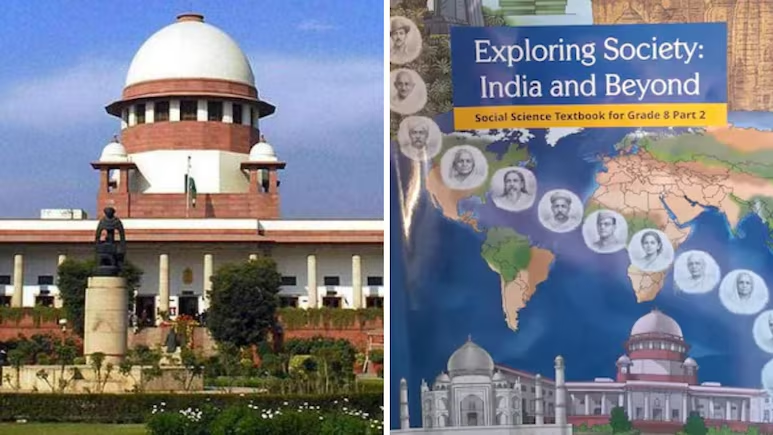

Supreme Court Bans NCERT: The Supreme Court of India on Thursday severely criticized the Centre and the NCERT in connection with a controversial mention of “corruption in the judiciary” in a newly published Social Science textbook for Class VIII students, demanding strict accountability and an immediate ban on the publication.
Expressing their strong displeasure, the court said that it would hold a further investigation to pinpoint the persons responsible for the publication. “We would like to have a deeper probe. We need to find out who is responsible… heads must roll! We won’t close the case,” the bench said while grilling Solicitor General Tushar Mehta, who appeared for the NCERT.
In a stern order, a bench headed by Chief Justice Surya Kant directed an immediate ban on the textbook, both within and outside the country. The court also directed the seizure of all copies of the textbook and a blanket ban on the publication of the content on social media platforms, either in full or in part. Notices were issued to the Union government as well as NCERT Chairman Dinesh Prasad Saklani.
The controversy is over a chapter called “The Role of the Judiciary in Our Society”, which contained references to corruption in the judicial system. The court held that such material, especially in a textbook for schoolchildren, could erode the public’s confidence in constitutional bodies and was not suitable for the elementary level of education.
Earlier in the hearing, Tushar Mehta told the court that the two persons who had brought up the contentious reference would never be linked to the University Grants Commission or any government ministry in the future. “We stand by the institution. No one will get away scot-free,” Mehta told the bench, trying to reassure the court that corrective measures would be taken.
But the Chief Justice was highly dissatisfied with this attitude. “That is of very little consequence. They fired a gunshot and the judiciary is bleeding today. This looks like a deep-rooted conspiracy – a very calculated move,” the bench said, implying that this was no ordinary mistake in editing.
The court also objected to an NCERT press release, which admitted that “inappropriate textual material had inadvertently crept” into the chapter and expressed “regret” over the matter. The bench said that this was not an unconditional apology, as the book was still available in the market, contrary to claims that it had been withdrawn. “It’s available… I got a copy from sources,” the Chief Justice said.
Mehta later told the court that 32 copies of the book had entered the market but had since been withdrawn. He told the bench that the entire chapter would be rewritten to eliminate objectionable material. The bench was also upset about another part of the chapter that referred to the pendency of cases and the phrase “justice delayed is justice denied.” “We cannot teach children that justice is denied,” the bench said.
The problem had first arisen the previous day when the Supreme Court had expressed “grave concern” over the references, pointing out that members of the judiciary, including High Court judges, were “perturbed” by the material. Later, government sources said that the objectionable parts would be removed, saying that “such references shouldn’t have been written” and that textbooks should contain more “inspirational and constructive stories.”
The new chapter, as per NCERT, had tried to move beyond the hierarchy of courts and access to justice, and had also tried to address issues like corruption and backlogs, while also focusing on judicial accountability and transparency efforts. However, it is clear that the court felt that it was not appropriate to discuss such sensitive topics without proper context and critical analysis for middle school students.
Experts have also joined the debate on the controversy. Senior advocate Sidharth Luthra has questioned whether it was appropriate to introduce such complex and sensitive topics at the Class VIII level, and that school education should aim to make children aware of the structure and working of constitutional bodies. Supreme Court lawyer Pragya Parijat Singh has stated that it was unfortunate that the topic of corruption was raised without proper analysis, and that it showed a lack of understanding of the role of the judiciary in the making of the Indian democracy.
The Supreme Court has made it clear that the issue will continue to remain under its scrutiny, and that accountability will be ensured.