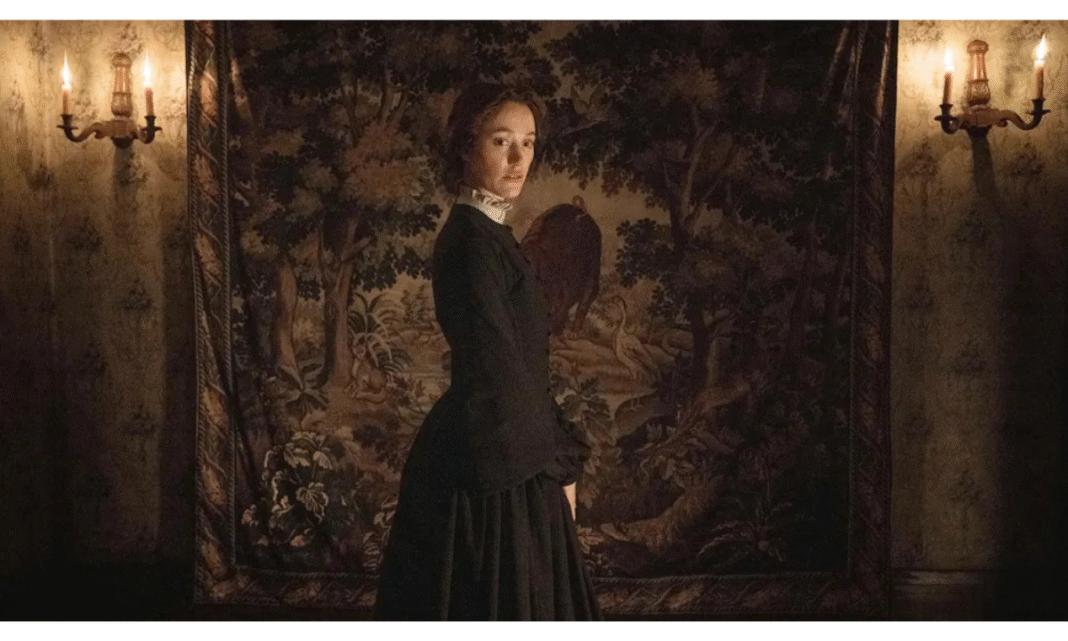

Maika Monroe, Jason Isaacs, Ruth Wilson, and Thomasin McKenzie in Zachary Wigon’s Genre‑Confused Adaptation of Virginia Feito’s Novel
Zachary Wigon’s Victorian Psycho, unveiled in Cannes’ Un Certain Regard section, arrives as a curious hybrid that cannot quite decide whether it wishes to terrify or amuse. Adapted from Virginia Feito’s novel, the film positions itself within the Gothic tradition, complete with Yorkshire Moors, gargoyle‑adorned manor houses, and whispers of Brontëan atmospherics. Yet instead of cultivating dread, it leans into exaggerated performances and arch theatricality, producing a spectacle that feels closer to parody than to horror.
At the center of this Grand Guignol is Maika Monroe, long celebrated as a modern scream queen, now cast against type as Winifried Notty — or “Fred,” the demon inside her. From the moment she arrives at Ensor House to serve as governess to the children of Mr. and Mrs. Pounds (Jason Isaacs and Ruth Wilson), her twitching tics and manic energy announce a character already dialed to maximum madness. The film never allows her menace to build gradually; instead, it presents her as a 19th‑century Patrick Bateman from the outset, robbing the narrative of suspense or shock.
The Pounds family themselves are hardly paragons of respectability. Their lineage is riddled with scandal, from ancestors executed for grotesque crimes to parents marked by syphilis and predation. Isaacs and Wilson chew the scenery with relish, but their flamboyance only underscores the film’s tonal confusion. Thomasin McKenzie, as jittery housemaid Miss Lamb, becomes another victim of Fred’s manipulations, terrified by fabricated tales of ghouls wandering the Moors. Even the children are treated unequally, with Andrew groomed for education while Drissila is dismissed as a vessel for fertility — a sly feminist jab that the film gestures toward but never fully develops.
Narratively, Victorian Psycho sketches Winifried’s dark past through voiceovers: a mother who tried to kill her, a clergyman guardian with dubious motives, towns haunted by missing or murdered children. These fragments suggest psychological depth, but Wigon’s direction pushes everything toward grotesque exaggeration. The severed ear that Fred casually snacks on epitomizes the film’s preference for shock imagery over sustained atmosphere.
Visually, the film is handsomely mounted. The manor’s interiors drip with Gothic gloom, and Ariel Marx’s storm‑laden score presses all the right ominous buttons. Yet the orchestration of dread never lands. Instead of fear, the audience is nudged toward incredulous laughter, as if the film were winking at its own absurdity. The hallucinatory sequences in which Fred imagines butchering the entire family flirt with surrealism, but they lack the control and precision that might have rendered them unsettling.
The cast, undeniably talented, is better than the material. Monroe throws herself into villainous mode with deranged gusto, but the performance feels one‑note. Isaacs and Wilson are amusing in their aristocratic grotesquerie, yet the pleasure wears thin. McKenzie’s nervous energy is squandered in a subplot that never coheres. The film seems convinced it is smarter, funnier, and more subversive than it truly is.
Only in its coda does Victorian Psycho achieve a measure of devilish unease, wrapping events in the cadence of an Olde English legend. By then, however, the damage is done. The thematic potential of Feito’s novel — questions of sanity, evil, and the darkness within us all — is diluted in a movie that hurtles forward without gathering momentum.
Ultimately, Victorian Psycho is a stylishly mounted but tonally incoherent experiment. It gestures toward Gothic horror, feminist satire, and camp comedy, but never commits to any. The result is a bloodbath that is neither frightening nor funny, a spectacle that leaves us not amused but bemused.