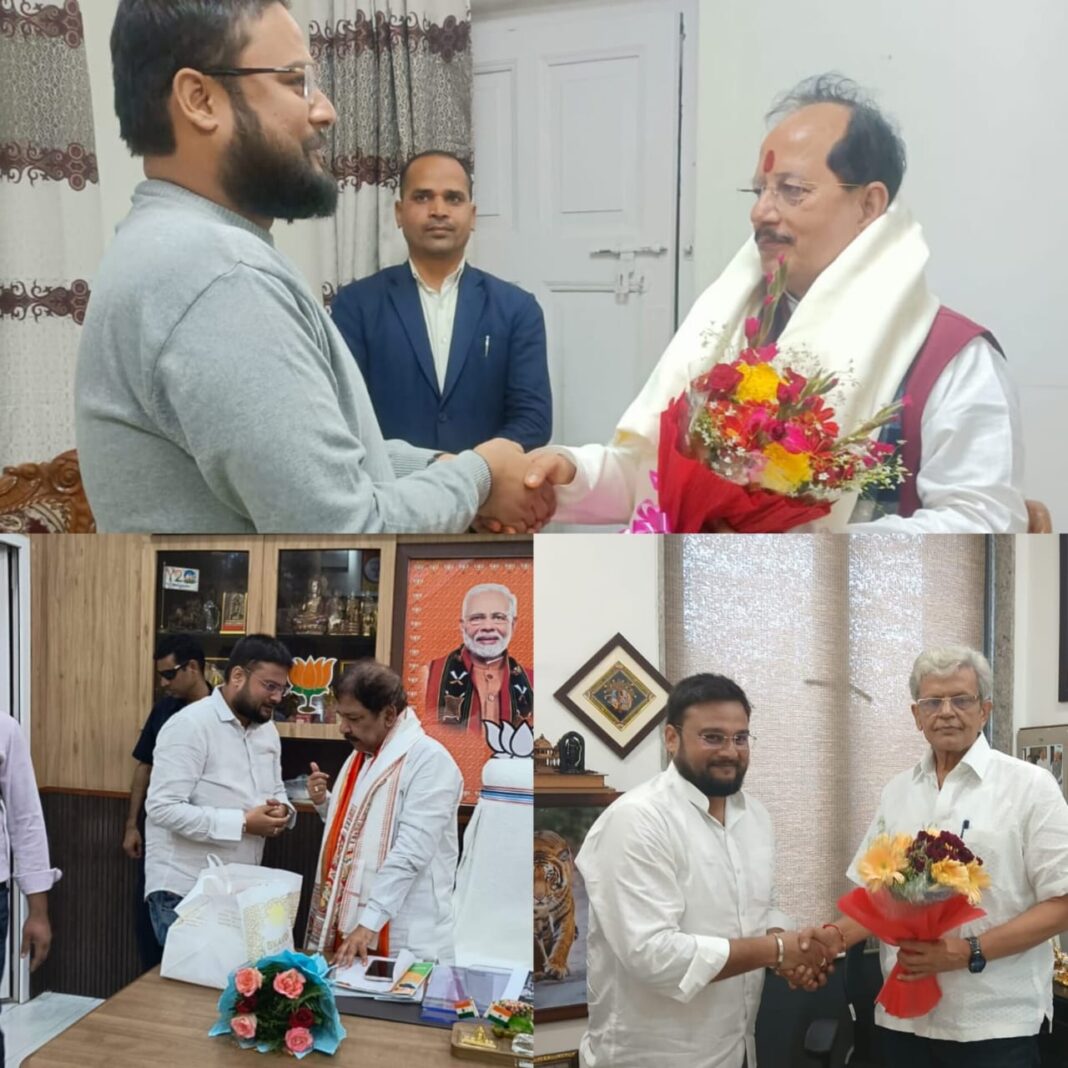

India’s ruling party appears to be standing at a decisive crossroads. The pace of political activity within and around the organization suggests that the Bharatiya Janata Party is no longer focused merely on managing power, but on carefully designing the architecture of its future. Under the leadership of Nitin Nabin, the party is visibly recalibrating its priorities placing long-term strategy, generational transition, and professional political management at the center of its thinking.
From Strategy Rooms to the Top Table: BJP’s New Blueprint Takes Shape
At the heart of this churn lies a development that has attracted intense attention within political circles in New Delhi: the possible appointment of Saket Saurabh as a key advisor to the new national president. According to senior sources, deliberations between the Rashtriya Swayamsevak Sangh and the BJP’s central leadership have reached their final stage.
What remains is not whether such an appointment is desirable, but how strategically consequential it could prove for the party’s future. Saket Saurabh is not an unfamiliar name in contemporary political strategy. Over the past decade, he has emerged as one of the select professionals who have shaped electoral outcomes from behind the scenes.
Nitin Nabin’s Moment and the Strategist Who Could Shape His Era
In Bihar, he has worked closely with several senior BJP leaders, handling political management, election strategy, and media advisory roles. Born and raised in Darbhanga, Saurabh’s early education was rooted in the same town. His journey from the heart of Mithilanchal to the nerve center of national politics reflects a rare blend of grassroots understanding and professional acumen. In 2019, he founded SPACS—Socio Political Analysis and Communication Strategy an organization that has since earned a formidable reputation in the field of political management. Within a remarkably short span, SPACS became known for its data-driven insights, disciplined communication strategies, and ability to translate social realities into political advantage. Party insiders openly acknowledge that the BJP’s recent landslide victories have carried the imprint of SPACS’s strategic input, making Saurabh’s potential elevation all the more significant. Interestingly, 2025 was also being widely discussed as the year when Saurabh might step into electoral politics himself. There was strong speculation that he could contest from Patna’s Kumhrar Assembly constituency. The coincidence is striking: the neighboring Bankipur seat was represented by Nitin Nabin, who today occupies the post of national BJP president. However, during deliberations within the central election management apparatus, Narendra Modi is said to have personally pointed to Saurabh’s age and long-term relevance, indicating that he was being groomed for a far larger responsibility. The current developments suggest that this assessment is now translating into concrete organizational action.
This prospective appointment is not merely about adding another advisor to the president’s office. It signals a deeper shift in the BJP’s strategic mindset. The party appears determined to systematically bring Generation Z into leadership and decision-making roles, while simultaneously handing over the reins to faces that represent continuity with change. Nitin Nabin’s elevation to the top post, combined with the possible inclusion of a strategist like Saket Saurabh, underscores a deliberate attempt to redefine how political authority and expertise interact within the party.
The role of the RSS in this process has been pivotal. The ongoing consultations between the Sangh and BJP leadership are not limited to individual appointments; they are about shaping the ideological and organizational trajectory of the party for decades to come.
The Architecture of the Future: BJP’s Calculated Bet on New Leadership
Approval of Saurabh’s role would indicate the BJP’s full endorsement of a professional, data-oriented approach Should Saket Saurabh formally assume an advisory position, the partnership could establish a new equilibrium between power and planning. Such a balance would not only be critical for winning elections, but also for expanding the party’s ideological footprint, nurturing future leadership, and mastering the demands of digital-age politics.
Taken together, these developments point to a party that is consciously investing in the future rather than reacting to the present. The potential collaboration between Nitin Nabin and Saket Saurabh embodies the BJP’s long-term vision one that seeks to harmonize tradition with experimentation, experience with innovation. If finalized, this move will not be remembered as a routine organizational adjustment, but as a defining moment in the evolution of India’s most dominant political force.