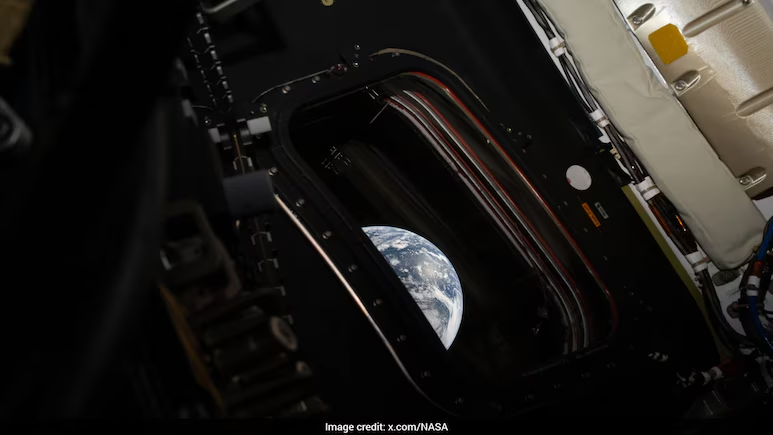

Orion spacecraft carries four astronauts on Artemis II, marking humanity’s return to deep space travel
Orion spacecraft: There could not have been a greater leap in terms of human space flight as Orion becomes an operational spacecraft capable of taking astronauts on board and completing its first mission around the Moon after being used only as a test vehicle before.
Orion took off on April 2 from Earth aboard NASA’s Space Launch System rocket for its first voyage towards the Moon with a crew of four astronauts—Reid Wiseman, Victor Glover, Christina Koch, and Jeremy Hansen—who would complete NASA’s first Artemis mission after half a century of absence on our natural satellite.
Life inside Orion
In Orion’s efficient but tight and pressurized capsule, the crew members have adjusted to the spacecraft built for efficiency and not comfort. This is because Orion, unlike the huge space station module, is small and efficient for deep space exploration.
As per initial feedback from the crew, the spacecraft is behaving perfectly without any technical problems. However, there was a little problem in the toilet system. This problem was sorted out by Christina Koch jokingly calling herself as the space plumber of the mission.
Built for deep space
Orion is an essential component of NASA’s strategy for exploring deep space. Unlike those spacecraft used for LEO (low earth orbit), it will have to function in regions where the protection offered by Earth’s magnetic field does not exist. This implies that it has to shield its passengers from dangerous levels of radiation, keep them alive through the entire journey, and withstand extremely harsh conditions in both directions.
It is built in such a way that it can accommodate up to four astronauts for a period of 21 days even when it does not dock with any other spacecraft.
Engineering and global collaboration
Orion will play a crucial role in NASA’s plan for venturing into deep space. It will differ from other spacecraft designed to travel into low earth orbit because it must survive in environments where there is no magnetic field to protect against harmful levels of radiation. In addition, Orion must ensure the survival of its crew members for the whole journey in both directions.
The design of this spacecraft allows it to carry up to four astronauts for 21 days without docking with any other spacecraft.
Structure and safety systems
There are three main parts of the Orion vehicle. First comes the Launch Abort System, which pulls the crew module out of harm’s way in the case of an emergency during the lift-off process. Luckily, it was not required for the present mission, because everything went according to plan.
The Crew Module is used by the crew as their working quarters. Here one can find control and communications systems, as well as a life support system. Most importantly, it is the only part of the vehicle to land back on Earth once the mission is completed.
Beneath it is the European Service Module, which may be regarded as the “heart” of the Orion spacecraft. All three together comprise a vehicle that can operate under the most difficult conditions in the Universe.
Built to survive extremes
One of Orion’s most remarkable features is its ability to withstand extreme heat during re-entry. When returning from the Moon, the spacecraft will enter Earth’s atmosphere at speeds approaching 30 times the speed of sound. This generates intense heat, requiring advanced thermal protection systems to keep the crew safe.
NASA engineers have designed Orion’s heat shield to endure these conditions, ensuring a safe return even from deep-space missions.
From Artemis I to Artemis II
The voyage of Orion started with the Artemis I launch, which was a test run without any crew. The second mission of Artemis is a milestone that takes us one step forward by having the first humans operate inside Orion during a real mission.
This is just a stepping stone in the path that NASA had laid out in their Artemis mission plan. Future missions under this project are aimed at establishing the first human settlement on the moon and then taking man to Mars.
In its voyage, Orion takes not just four astronauts but mankind’s dream of space travel beyond imagination.