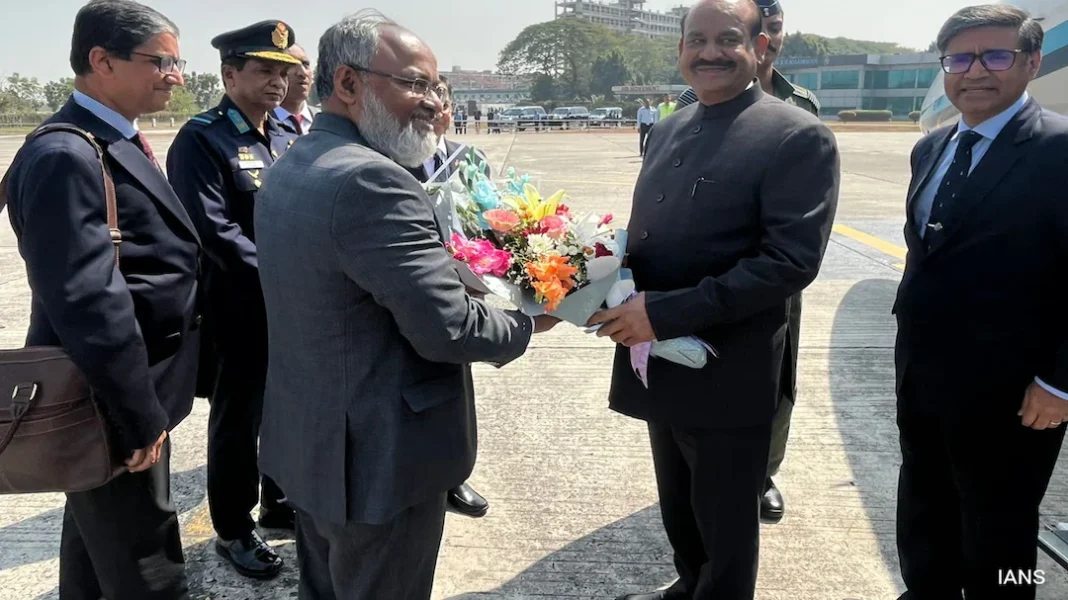

Om Birla in Dhaka : Bangladesh is on the threshold of a major political shift as Tarique Rahman is set to take the oath of office as the new Prime Minister of the country in the wake of the recently held 13th parliamentary elections. The oath-taking ceremony is set to take place at the South Plaza of the National Parliament Building in Dhaka, with a huge turnout of political leaders, foreign diplomats, and other high-ranking guests from around the world expected to attend. It is estimated that close to 1,200 dignitaries will attend the ceremony.
Rahman’s political party, the Bangladesh Nationalist Party (BNP), has come out as the winning party in the elections by winning 209 seats out of the total 297 contested seats, thus giving them a clear majority to form the government on their own. The right-wing Jamaat-e-Islami has come second by winning 68 seats, thus making them the second-largest party in the Parliament. The results have completely changed the political scenario in the country, especially since the Awami League, led by former Prime Minister Sheikh Hasina, has been banned from taking part in the elections.
The oath-taking ceremony follows a tumultuous period in Bangladesh’s recent past, which has seen political instability and a fatal uprising in 2024 that has left the nation bitterly divided. Rahman’s ascendance is seen as a combination of public demand for a new order and a challenge to the BNP’s capacity to provide stability and economic development. Rahman will mark the first male head of state to hold the office of prime minister in over three decades if he is indeed sworn in as planned.
Earlier in the morning, the newly elected Members of Parliament were sworn in by Chief Election Commissioner AMM Nasir Uddin, marking the end of the procedural formalities necessary before the establishment of the new government. The swearing-in ceremony was held under tight security, with transparency and constitutional compliance being highlighted. The rapid organization of the parliamentary formalities has been seen as a move to ensure a smooth transfer of power.
The international focus on the event has also been significant. From India, Om Birla, Speaker of the Lok Sabha, has come to Dhaka to attend the swearing-in ceremony, which is an indicator of the significance of diplomatic relations between the two neighboring countries. His presence is an indication that New Delhi is committed to having good relations with Bangladesh, irrespective of the political developments in the country. Other foreign dignitaries are also expected to attend the ceremony.
However, amidst the festive mood, some political issues have yet to be resolved. The BNP has refused to take a secondary oath related to the Constitution Reform Commission and the widely discussed “July Charter” referendum, claiming that the provisions of the council have not yet been incorporated into the Constitution. This move has been widely questioned by constitutional experts and opposition politicians, who believe that it is essential to have a clear understanding of the reforms in the early stages of governance.
Analysts think that the first few months of the new government will be critical in determining the kind of politics that will be practiced in the country. With high expectations from the people and the dynamics of the region changing, Rahman’s presidency will be under intense scrutiny. The next few days will determine not only the future of politics in Bangladesh but also its position in the South Asian region.