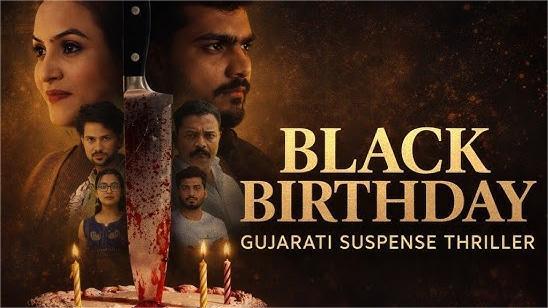

A Psychological Noir That Redefines the Moral Landscape of Gujarati Cinema
Language: Gujarati
Release Date: 13 February 2026
Genre: Psychological Thriller / Suspense Drama
The evolution of Gujarati cinema has long been marked by its allegiance to familial sentiment, cultural warmth, and conventional emotional arcs. Against this familiar backdrop, Black Birthday arrives not merely as a film, but as a provocation—an unsettling cinematic inquiry that dismantles comfort, interrogates human duplicity, and reimagines the genre of suspense within a regional framework. Released theatrically on 13 February 2026 under the banner of Studio Arva Production, the film positions itself as a daring psychological noir, unapologetically sombre in temperament and intellectually demanding in execution. In an industry often inclined toward sentimentality and formulaic spectacle, Black Birthday emerges as a disquieting anomaly—an austere, psychologically charged suspense drama that refuses comfort, certainty, or easy catharsis. This Gujarati-language thriller dares to excavate the darker recesses of human relationships, transforming a ritual of celebration into a nightmarish crucible of secrets, betrayal, and existential dread.
Rather than courting mass appeasement, Black Birthday chooses austerity, ambiguity, and moral discomfort. It is a film that withholds reassurance, offering instead a labyrinth of fractured relationships, concealed motives, and ethical corrosion. The result is a work that lingers—not through spectacle, but through the quiet terror of realization.
Black Birthday stands as a brooding and intellectually rigorous addition to Gujarati cinema, distinguished by its somber temperament and psychologically intricate storytelling. Crafted under the banner of Studio Arva Production, the film is directed and written by Brijesh Bauddh and Shahid Ali, whose measured, slow-burning narrative approach allows tension to accrue organically rather than erupt theatrically. Produced by Sahil Patel and Vishal Prajapati, the film transforms a seemingly celebratory occasion into a harrowing exploration of jealousy, suppressed desire, and moral disintegration. The cinematography by DOP Durjey Soni employs shadow-heavy frames and intimate compositions to intensify the sense of claustrophobia, while the background score and 5.1 mixing subtly amplify unease without overpowering the drama. Strong performances by Yogita Patel, Aarjav Trivedi, Chetan Daiya, Jitendra Thakkar, Dhruvi Soni, and an able supporting cast lend emotional credibility to the unfolding mystery. With precise editing by Prashant Yadav and a disciplined technical crew overseeing art direction, costumes, and sound, Black Birthday emerges as a restrained yet compelling suspense drama that privileges psychological depth and narrative intelligence over formulaic thrills.
Conceptual Foundation and Narrative Philosophy
At its conceptual core, Black Birthday subverts one of society’s most intimate rituals: celebration. A birthday, typically emblematic of renewal and affection, becomes the site of emotional implosion and irreversible tragedy. The film opens with an ostensibly convivial gathering among friends, yet from its earliest moments, an atmosphere of unease permeates the frame. Conversations feel guarded, silences weighted, and smiles performative.
A shocking incident—initially interpreted as suicide—ruptures the evening and destabilizes every relationship within the group. However, the film is less concerned with the mechanics of death than with the psychological wreckage it exposes. As the investigation unfolds, certainty dissolves. Truth fragments. Allegiances shift. Every character becomes both witness and suspect, victim and perpetrator.
The screenplay resists linear revelation. Instead, it unfolds through incremental disclosures, allowing suspicion to ferment gradually. This narrative patience is one of the film’s defining virtues. Black Birthday does not shock impulsively; it corrodes slowly.
Themes: The Anatomy of Human Darkness
The thematic ambition of Black Birthday far exceeds the conventions of a standard murder mystery. While crime forms the narrative catalyst, the film’s true preoccupation lies with moral decay and psychological contradiction. It explores:
The duplicity inherent in intimate relationships
The quiet violence of jealousy and emotional dependency
The fragility of friendship under the weight of unspoken resentment
The ease with which love curdles into obsession
The film’s most unsettling proposition is that guilt is not always tied to action, but often to intention. Characters may not wield the weapon, yet their silence, manipulation, or emotional cruelty implicates them equally. In this moral universe, innocence is provisional, and responsibility is collective.
This philosophical undertone elevates Black Birthday beyond genre mechanics, transforming it into a study of ethical erosion.
Performances: Precision Over Exhibition
The ensemble cast delivers performances marked by restraint, psychological acuity, and internal tension. There is a conspicuous absence of theatrical excess; emotions are modulated, expressions controlled, and dialogue underplayed—choices that align seamlessly with the film’s tonal discipline.
Yogita Patel anchors the film with a performance of remarkable composure and emotional intelligence. Her character occupies the narrative’s moral epicentre, oscillating between vulnerability and inscrutability. Patel resists overt dramatization, allowing micro-expressions and silences to convey inner turbulence. Her portrayal is not designed for immediate sympathy; instead, it invites scrutiny, reinforcing the film’s culture of suspicion.
Aarjav Trivedi delivers a psychologically charged performance that thrives on ambiguity. His character’s motivations remain deliberately opaque, sustained through controlled body language and a carefully moderated emotional register. Trivedi’s greatest strength lies in his refusal to telegraph intent, keeping the audience in a state of perpetual unease.
Veteran performers Chetan Daiya and Jitendra Thakkar provide narrative ballast. Their performances lend gravitas to the investigative dimension, grounding the film’s philosophical inquiry in procedural realism. Both actors bring a lived-in authenticity that prevents the film from drifting into abstraction.
Supporting performances by Dhruvi Soni, Smit Joshi, Magan Luhar, Kalpesh Patel, Gaurang Jedi, and others are uniformly credible. None are ornamental. Each character contributes to the narrative’s psychological mosaic, reinforcing the film’s commitment to ensemble integrity.
Direction and Screenplay: The Power of Withholding
Directed and written by Brijesh Bauddh and Shahid Ali, Black Birthday exemplifies the virtue of narrative restraint. The filmmakers eschew sensationalism, choosing instead to cultivate tension through atmosphere, dialogue, and psychological proximity.
The screenplay is meticulously structured, devoid of superfluous subplots. Each scene advances either character revelation or thematic inquiry. Conversations are imbued with subtext; confrontations unfold obliquely rather than explosively. The directors trust the audience’s intelligence, allowing meaning to emerge through implication rather than exposition.
This slow-burn methodology may test impatient viewers, but it rewards attentiveness. By the film’s final act, the accumulated tension achieves a suffocating intensity, making the eventual revelations feel both inevitable and devastating.
Cinematography: Visual Claustrophobia as Psychological Metaphor
The visual grammar of Black Birthday is defined by confinement. Shot by cinematographer Durjey Soni, the film employs shadow-heavy lighting, muted colour palettes, and tightly framed compositions to evoke emotional entrapment.
Interior spaces dominate the narrative, reinforcing a sense of inescapability. The camera frequently lingers at an uncomfortably intimate distance, denying characters—and viewers—any emotional refuge. This visual claustrophobia mirrors the characters’ psychological imprisonment within their own secrets.
Rather than aesthetic flamboyance, the cinematography prioritizes mood. Every frame feels deliberate, reinforcing the film’s overarching sense of dread.
Editing, Sound, and Technical Craft
Editor Prashant Yadav maintains a measured rhythm that aligns with the film’s introspective tone. Cuts are unobtrusive, allowing scenes to unfold organically. The pacing never capitulates to urgency, sustaining tension through duration rather than acceleration.
The background score and 5.1 sound mixing remain understated, favouring atmospheric unease over melodic intrusion. Silence is used strategically, often more unsettling than sound itself. This sonic minimalism enhances the film’s psychological realism.
Production design, costumes, and makeup are subdued yet purposeful, reflecting the characters’ inner states without drawing attention to themselves. The technical departments operate in quiet synergy, reinforcing the film’s disciplined aesthetic.
Production Vision and Collaborative Strength
Produced by Sahil Patel and Vishal Prajapati, Black Birthday reflects a cohesive production vision that privileges narrative integrity over commercial compromise. The extended crew—spanning art direction, costume design, editing, marketing, and sound—demonstrates a shared commitment to tonal consistency.
Studio Arva Production’s decision to support such a thematically austere project signals a progressive shift within Gujarati cinema, suggesting an openness to experimentation and psychological complexity.
Cultural Significance and Industry Impact
Within the broader context of Gujarati cinema, Black Birthday represents a meaningful departure from genre orthodoxy. Its embrace of moral ambiguity, psychological realism, and narrative patience positions it as a landmark experiment—one that challenges both filmmakers and audiences to reconsider the possibilities of regional storytelling.
The film does not seek universal approval. Its darkness is unflinching, its conclusions unsettling. Yet it is precisely this refusal to console that grants it artistic legitimacy.
Final Evaluation
Black Birthday is not entertainment in the conventional sense; it is an experience—demanding, introspective, and quietly harrowing. It rewards viewers willing to engage with discomfort, ambiguity, and moral complexity. While its deliberate pacing and restrained affect may alienate some, those attuned to psychological cinema will find it a rare and resonant achievement.
In dismantling the illusion of innocence and exposing the quiet brutality of human relationships, Black Birthday stakes a bold claim for Gujarati cinema’s evolving maturity.
Key Themes
Moral complicity and shared guilt
The instability of truth
Emotional violence within intimacy
The illusion of innocence
Aesthetic Approach
Low-key lighting and confined interiors
Minimalist background score
Performance-driven narrative structure
Emphasis on silence and implication
Critical Positioning
Black Birthday positions itself within the tradition of psychological noir, offering a rare example of philosophically driven suspense in Gujarati cinema. It challenges genre expectations by prioritizing ethical inquiry over narrative closure.
Rating: ★★★☆☆ (3/5)
Recommended For:
Admirers of psychological thrillers
Viewers seeking intellectually rigorous cinema
Audiences open to moral ambiguity and narrative restraint