
Introduction
New Delhi, November 1, 2025 — The Congress party has sharply criticized the Delhi government’s much-publicized cloud seeding experiment, calling it a “cruel joke” on citizens struggling with toxic air. The remark came after officials claimed that the artificial rain technique brought temporary relief in select areas of the capital. While the Aam Aadmi Party (AAP) government has touted the experiment as a scientific effort to combat pollution, the opposition argues it was merely a “publicity stunt” with negligible results.
The Cloud Seeding Experiment
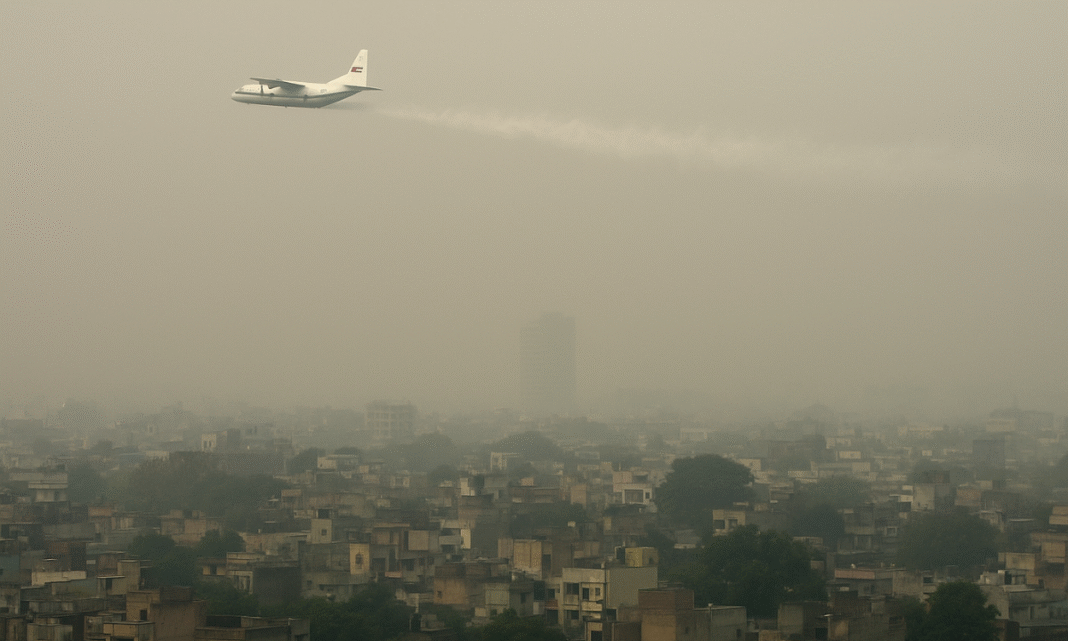
In an attempt to improve Delhi’s deteriorating air quality, the state government recently carried out a cloud seeding operation — a process that involves spraying certain chemicals into clouds to induce rainfall. The initiative was conducted in partnership with scientists from the Indian Institute of Technology (IIT) Kanpur and other research organizations.
According to the Delhi government, the operation resulted in light rainfall across parts of South and Central Delhi, which slightly reduced the Air Quality Index (AQI) levels for a short duration. The Chief Minister’s Office (CMO) claimed the trial was a “scientific success” and expressed optimism about future experiments on a larger scale.
However, environmental experts pointed out that the relief was highly localized and short-lived, with pollution levels rebounding within 48 hours.
Congress’s Sharp Criticism
The Congress party was quick to react. In a strongly worded statement, a Congress spokesperson said,
“Getting slight improvement in a limited area for a day or two, while the rest of Delhi continues to choke, is nothing short of a cruel joke. The government has failed to take sustainable measures, and now it is resorting to gimmicks.”
The party accused the AAP government of diverting attention from more pressing issues such as waste management, vehicular emissions, and stubble burning. Senior leaders emphasized that artificial rain cannot replace long-term solutions like renewable energy transition, stricter emission norms, and better urban planning.
Political and Public Reactions
While AAP leaders defended the move as an “innovative environmental step,” the Congress maintained that Delhi’s pollution crisis demands policy, not theatrics. Several residents expressed mixed reactions. Some welcomed the rainfall as temporary respite from the smog, while others criticized the state for failing to ensure cleaner air throughout the year.
Political analysts believe the debate around cloud seeding has turned into a symbolic battleground — representing two contrasting approaches to governance. “For AAP, it’s about showcasing technological innovation; for Congress, it’s about questioning accountability,” said one observer.
Environmental Experts Weigh In
Experts are divided on whether cloud seeding can offer a sustainable solution. Meteorologists explained that successful cloud seeding depends heavily on weather conditions, humidity levels, and cloud density — factors that cannot be guaranteed.
Dr. Anil Mehta, an environmental scientist, said,
“Cloud seeding may provide short-term relief, but it is not a viable long-term measure to control pollution. The government should focus on curbing emissions from vehicles, construction, and industries.”
He added that a multi-agency, inter-state approach is necessary to tackle Delhi’s chronic air-quality issues, especially during the winter months when pollution peaks due to stubble burning in neighboring states.
The Larger Picture
Delhi’s air quality has consistently ranked among the worst in the world, with AQI levels crossing the hazardous mark every winter. The government’s experiment, while innovative, has sparked a larger conversation about science versus politics in environmental governance.
The Congress’s criticism reflects growing public frustration with temporary fixes in the face of a recurring health emergency that affects millions. As both the central and state governments exchange blame, citizens continue to demand cleaner air, transparent planning, and accountability.
Conclusion
While the Delhi government’s cloud seeding project marks a bold attempt at scientific intervention, its limited results have opened the door to political attacks and skepticism. The Congress’s description of the initiative as a “cruel joke” highlights a deeper issue — that fighting pollution in the capital requires consistency, collaboration, and credible action rather than experimental optics.
Only time will tell whether such scientific experiments can evolve into meaningful solutions or remain political flashpoints in India’s ongoing battle for clean air.